Young Talents Club Experiment
How can I create a cloud in a pickle jar?
How are storms created?
Clouds come in many different shapes, sizes, and colors. In this experiment we will dive a bit deeper into the science of cumulonimbus (storm) clouds specifically.

With Scientist Bety Pechacova
Age: 23 years
Research: Atmospheric Physics
Bety is a PhD student in Atmospheric Physics in the Muller Group at ISTA, where she uses simulations to investigate the factors that determine storm intensity. Originally from the Czech Republic, she studied Physics in the United Kingdom before moving to Austria for her doctoral studies. Outside of her research, she enjoys hiking, painting, strength training, and reading.
The lifecycle of a cumulonimbus cloud
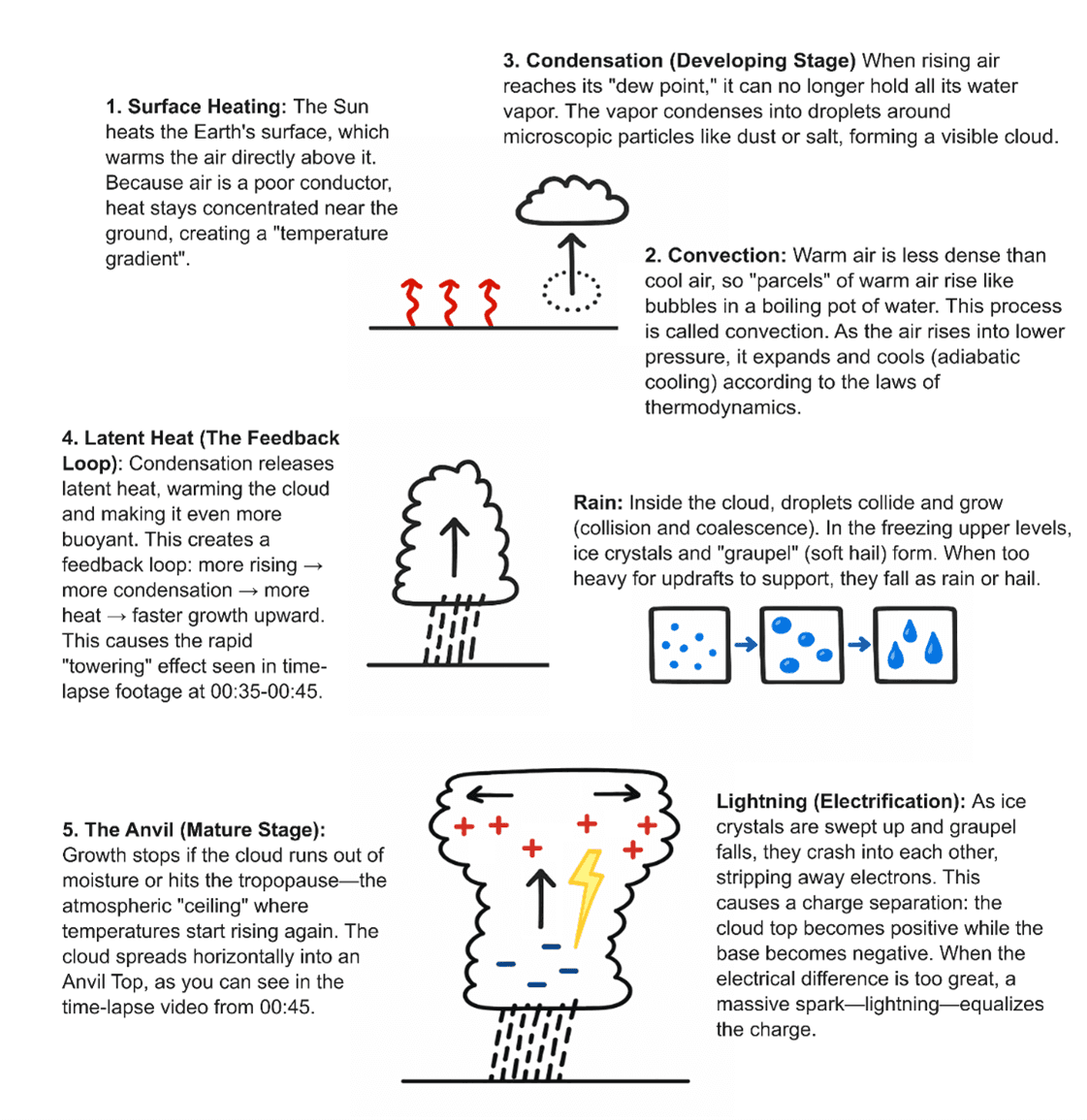
Exciting fact
Clouds don’t just influence how much rain or sunshine we get on a given day, but also how warm the whole Earth will be and how temperature and humidity will be distributed around the planet. Clouds often look very different because they are created by different processes at different conditions.
Create your cloud in a pickle jar
You will need:
A glass jar with a lid
Hot water
Ice cubes
Matches or an aerosol spray (hairspray, deodorant, air freshener,...)
Dark paper, fabric or different surface as a background
The cloud in a pickle jar
Step 1
Put some hot water into the jar (a few centimeters is enough, the water should be hot but doesn’t need to be boiling). Swirl it around a little to warm up the sides of the jar.
Step 2
Place the lid upside down on the jar and put some ice cubes on it. Wait around 20-30 seconds, you might already see some condensation in the jar.
Step 3
Remove the lid and spray a bit of your aerosol spray into your jar before returning the lid. Or, if you are using a match, light it, hold it at the top of the jar for a few seconds, drop it in, and replace the lid.
Step 4
Now you should see a cloud condensing and forming, if you have some dark paper or wall behind the jar it works best. If you have enough “cloud” in your jar, you can remove the lid and see your cloud rising!
Keep exploring!
Why does a cloud form in the jar? Can you describe the different processes?
This experiment is a mini version of what happens in the atmosphere, can you describe how?
What do the hot water and ice cubes represent? What effect do they create?
What does the aerosol spray or smoke from the match do? What plays this role in the real world?
Bonus Experiment - Pressure Effects
You may have heard weather forecasters talking about pressure and showing maps of high and low pressure. Pressure, like temperature, influences how much water vapor air can hold before it starts condensing into a cloud.
You can try this with your jar, either compressing the air by putting a balloon over the top (see the end of this video) or by using a plastic bottle which you can deform (like here).